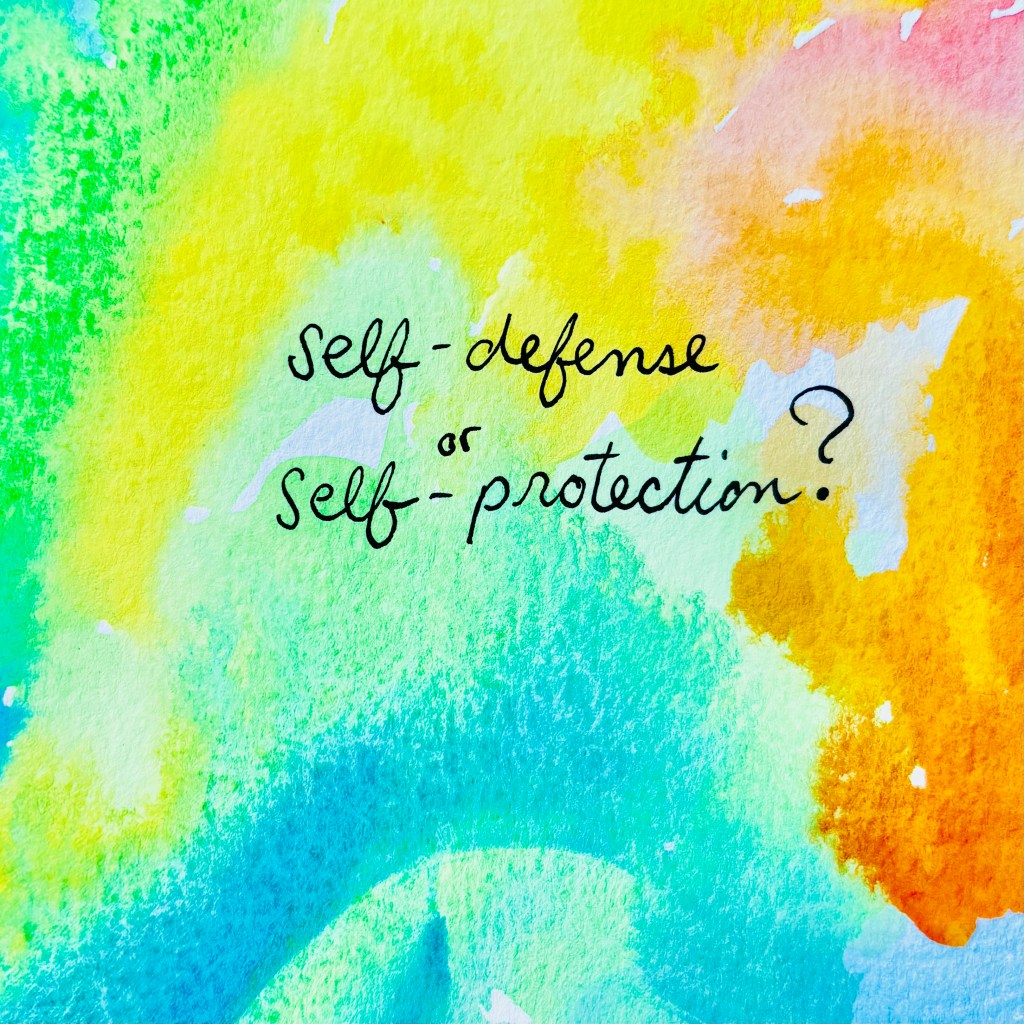
Self-defense can be a mindset, a way of life. It’s a way of life I’ve been living since I first took martial arts classes as a young teenager. But is it a healthy mindset, a healthy way of life?
As a student in my first tae kwon do school in the 90’s, the focus of our youth program was on building confidence, self-esteem, and discipline. We did the endless drilling of kicks, punches, and forms, but we also learned ways to avoid fighting. We were taught to always use our words before our fists. Fighting was a last resort.
I remember with great clarity in one class I took as I was training for my black belt, our teacher, Master Hafner said to us, “I don’t want you to get in a fight, but if you do get in a fight, I want you to win.” I was a bit rattled by this sentiment–the thought of him wanting us to beat someone up. But I was also inspired– our teacher cared about us, and wanted us to care about ourselves enough to fight for ourselves.
Perhaps this is the primary positive mindset of self-defense: I am worth defending, and I will defend myself. I’m grateful that I learned that mindset early on. It can be a mindset of self-love. Years later in my training, as a kung fu student in Portland, another teacher gave me a self-defense golden nugget. Professor Barbara Bones said at a women’s training camp, “Defending yourself is not only your right. It is your responsibility.”
That one still shakes me up inside. To me it means that even if I don’t want to fight for myself, if I’ve lost my sense of self-worth and don’t care if I get beaten up, it is still my responsibility to defend myself to my best ability. There are others in the world that love me, and I owe it to them to be responsible for my own wellbeing. I also owe it to my future self.
Self-defense training has been threaded through all of the martial arts I’ve studied since tae kwon do. Notably, while studying karate at Thousand Waves in Chicago in the early 2000’s, I took the requisite self-defense courses to get my green belt. The self-defense training there was excellent–some of the teachers at Thousand Waves had been involved in the feminist self-defense movement of the 1970’s. Many were from the generation who had to break the gender barrier to be allowed to train in traditional martial arts schools. Training at Thousand Waves gave me a new understanding of the history of women in the martial arts in the United States, and how that history was connected to the feminist movement. I also gained a much deeper understanding of what it meant and what it took to defend myself.
When I moved to Portland in 2005 and started training in Mo Duk Pai kung fu, I got more practical fighting experience than I’d ever had before. Mo Duk Pai is a mash-up of a bunch of different styles, but ultimately a brutal street-fighting art. Once I was training in the higher levels of Mo Duk Pai, we practiced full-contact, full-speed multi-person self-defense drills. I learned the importance of keeping my guard up because I got punched in the head if I didn’t. I learned never to cross my feet when fighting because it’s too easy to get tripped with crossed feet. I learned to make myself big, scary, and loud to intimidate the students who were my attackers.
All of this training was fantastic for my fighting mindset and my confidence, but at one point I started feeling paranoid. I was so used to fighting in class multiple times a week that I almost expected to be jumped in public at some point. I never was jumped, but my stress and paranoia level was certainly elevated during that time. After weeks or months of feeling this stress and paranoia, I realized it wasn’t helping me. I wasn’t any more ready for a fight because I was worried about it. This was the first time in my life that I realized a self-defense mindset could be harmful.
I still think a self-defense mindset can be harmful, and I’ve only come to question it more as I’ve matured in my practice. As a woman, my number one self-defense concern has always been sexual violence. I’m scared of getting groped, assaulted, or raped by a man. The mindset of self-defense assumes there is or will be an offense occurring. And though the offense is happening to me, and the offender is in the wrong, the wrong becomes my responsibility (and some would believe my fault) when it is done to me.
This is an unfair emotional burden that I bear for men’s potential misdoings. I realize I’m being gendered here, because certainly people of any gender can commit violence against me. However, in at least 90% of the self-defense encounters I’ve experienced, the perpetrator was a man (in none of these instances did I have to physically fight). This makes me angry–I see it as just one more way our patriarchal culture tries to keep me small and scared.
That’s a victim-y place for me to come from, and maybe that’s why I don’t like the self-defense mindset–it can be that of a victim. I don’t want to be a victim. I want to be Michelle.
I’m getting back into teaching self-defense in a formal setting this fall, and that’s why I’m thinking about the paradigm of self-defense so much. I don’t want to teach my students to be victims, I want to teach them to be more fully themselves. If something inappropriate is happening to them, I want them to loudly declare that the perpetrator is in the wrong. I want them to know what their boundaries are and to enforce them.
It’s self-protection that I want to teach more than self-defense. Protecting ourselves doesn’t assume offense or defense, it is just protecting what is ours. I want to teach and learn with my students that protecting ourselves is an extension of self-love. Self protection can come from inside of us and radiate outward from us– it is simply us claiming and owning what is ours.
I’m looking forward to what my students and I will discover as I lead classes from this place of loving protection. I’ll let you know what happens.
 Michelle Folk Johnson