Standing.

I’ve been training in an esoteric Tai Chi style since last April. Most of the practice is a personal practice, but recently our teacher, who lives far up in Canada from my perspective, came through the Pacific Northwest. While she was in my neck of the woods, I trained with her and a group of my fellow students over the course of six days.

While what she teaches is, on the surface, a physical practice, I find the system holds great value for me as a set of tools for a deeper understanding of self. Within the system my teacher shares, we train together to “increase awareness, expand consciousness, and rest into presence.” (<— I think those are the right words, someone tell me if I’m wrong :))

The method we use in her classes to practice awareness, consciousness, and presence is deceivingly simple: We stand in our bodies and allow resting into center. From there, everything arises.

The problem is, standing and resting into center is soooo very NOT easy to do. Even now, after practicing this “Wuji Standing” regularly since April (which, of course, amounts to a split second in Taiji time) my standing practice goes like this:

I begin standing.

“Okay, here goes, settle into standing. Ahh. That feels nice. Oh, energy down, right, 60% down, 40% up. Oh! My lower dantian, right, I’m supposed to start from there, I’d better start all over again…NO! I’ll go from where I am, that’s what I’m supposed to do. Ahhhh, dropping into the earth earth earth. Good. Oh shit, I’m clenching with the outside edge of my left foot again. Allow that to release. Ahhh. Aaaaand there. The tailbone gets to slide toward the earth, I just learned that one, it feels so good, I remembered when I learned how to allow that tailbone to drop by augmenting the opening with my hands it was one of the best sensations my body has ever felt. Like I’d opened the door to a new room in my house. Maybe that’s what that recurring dream is about! The one where I find a new room I never knew about? The other night I had one where my basement ceiling extended 20 feet higher than I realized. So much space. New possibilities in life, new potential. I should write that down… No! I’m standing right now. My upper back hurts. I bet I need to lean forward just a tad, I’ll try that. No, I won’t “try” it, I’ll “allow” it.  And when that happens, head “is invited” back a tiny bit. Thhhhere. Ah. OH! Listen behind, ok, listening. Be aware of back energy. Yes. Ok, now I’m ready to start.”

That’s the first two minutes or so. Two, monkey-minded minutes of what is, in essence, a standing meditation. Then I stand more.

There are worlds within ourselves to discover during standing. For example, very early in my practice with this teacher, seven or eight years ago, I stood in front of her and she observed my posture:

“You’re holding your sternum up. Why are you doing that?” she asked gently and honestly.

I felt for the first time that I was, indeed, always holding my sternum up high. Sticking my chest out. I felt how that posture held residue from when I was the drum major of my high school marching band. How that posture was me feeling “important, in charge, strong, proud.” I let it relax.

“That’s me being ‘proud’ and ‘important,'” I told her. And as I said that, for some reason, tears began streaming down my face. I had emotions tied to that sense of pride and  importance.

I remember, I held a little shame when I told her that. I was embarrassed that I had been putting on that posture, and embarrassed that she could see it. I felt that something I was trying to hide, something I didn’t even know I was trying to hide, was obvious. For some reason, I expected her to tell me I was weird for thinking my posture had anything to do with my feelings. Or to tell me why those feelings were a problem.But she just held me in her eyes and nodded.

“So then the question,” she said, “is who are you when you’re not having to be that ‘proud,’ ‘important’ person?”

“I don’t know,” I replied. More crying.

She nodded again. The not-knowing was OK.

To me, the unexpected compassion and lack of judgement she offered in that vulnerable moment was an enormous gift. It was one of the touchstone moments that led me back to training with her all these years later.

So lately, as I practice standing on my own, I have the option to feel what is happening in my body, and I can begin to understand why it’s happening. Where am I holding tension? What are the patterns my body has been gripping onto without me realizing them?

Perhaps the gripping in my left foot is residue from years in tiger stance in my old hard style. That foot turn translates to me trying to “protect” myself.

The arch in my back is, perhaps, residue of my trying to get the attention of the boys in eighth grade. It’s me trying to be “sexy.”

The knit brow is me “concentrating” in a very serious way. Work must be HARD!!!!

My slightly clenched jaw is me trying to grasp onto and control things.

My leaning forward is passion, fire, anger, aggression, excitement.

The days I lean back I feel fear, shame, overwhelm, hollowness.

The purpose of standing practice is not to get rid of all of these things; they make up pieces of who I am. The practice is to become aware of them. To let them come out of the shadows of being unconscious habits and into the light of being understood patterns. Once these patterns of tension– be they physical, mental, emotional, or spiritual tension– come into the light of consciousness, I can notice them. I can accept them, and in turn, accept pieces of myself that had been invisible to me.

From there I can have influence over the patterns, and feel whether it is of value to “put them on” or not. From that consciousness and influence, a greater sense of being in the present moment– a present moment without unconsciously defaulting to pattern– arises.

***

I find many unconscious patterns in my body every time I stand, but sticking my chest out to be ‘proud’ or ‘important’  is no longer one of my main defaults. (At least I don’t think so :)) To revisit the question posed to me years ago, “Who am I when I’m not being ‘proud’ or ‘important’?”

The answer is still that I don’t know.

But as I continue my practice, as I allow more patterns to arise and resolve, I get a feeling of who (or what) is underneath all of those patterns and defaults. The feeling is a sense of self underneath the self, of empty nothingness that is full of everything, of an entirely inclusive but completely detached form of love. The closest word I have to describe that feeling is “home.”


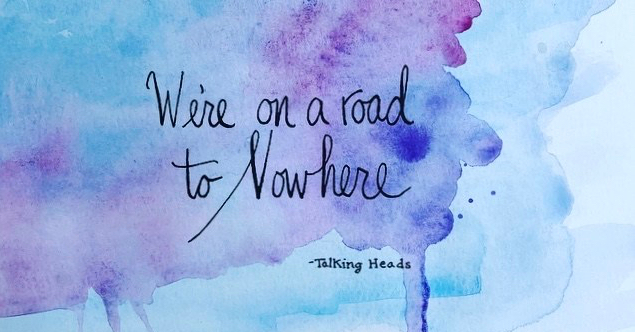
*(To explain the illustration, when I got back from my Taiji workshop, I sat in a bar while waiting for a friend and started to write about the workshop experience. The song “Road to Nowhere” by Talking Heads came on. I thought, “What a perfect song to express a practice where you stand in one place without trying to get anywhere. Or maybe we are actually practicing in order to get ‘nowhere.'” Either way, it’s catchy and quite danceable, and I think David Byrne is probably a genius.)

Loving Myself As I Love My Kids

During my first few years as a parent, I bought into the idea that I was supposed to love my kids more than anything else. I heard and read the words of other parents:

“My life had no meaning before I had kids. Now my life makes sense.”

“I never knew love before.”

“All I want to do is stare at his face all day. Everything else melts away…”

I settled into the notion that now there were people in the world that I was supposed to love more than my spouse, more than my parents, more than myself.

And I did love them differently than I had ever loved people before. When my son was born, I held him in my arms in the recovery room. I had the distinct notion that I loved him with my feet. I could feel my love for him all the way into my swollen feet, the left one especially, a warmth that had never been there before.

So, a new capacity for love? Yes. When I birthed my son and later my daughter, I birthed within myself a new capacity for love.

But did this mean that I was supposed to pour all of that newfound love directly into my children?

At first the answer was, “Of course! That’s what being a mother means!”

But now I don’t think so.

If I’m taking all of my love and putting it into another, then along with that love, I’m unwittingly putting pieces of myself. My expectations, my needs, my hopes and dreams. Those expectations, needs, hopes, dreams–those become the strings attached to the love I give another, be it my child or a partner, a friend or a family member. Then that love, perhaps innocently given, can so easily turn into pressure. And if that love is not returned in the way that I want it to be returned, I could so easily become bitter.

During my Creativity Practice, as I sat in silent contemplation one evening, I heard the words in my head:

“I am to love myself as much as I love my children.”

Whoa.

We aren’t necessarily programmed to think this way. We seem to have a collective archetypal image of the mother who suffers for the sake of her children. And while some mothers perhaps need to suffer to create a better life for their children, I am not in that situation this time around. I live a comfortable, relatively easy life, and for that I am grateful.

At first the thought of loving myself as much as I love my children seemed almost sacrilegious. But then I thought, if I’m using all of my love to attend to my children’s desires, hopes, dreams, then who is attending to mine? Nobody. And then what am I teaching my children to do? I’m teaching them to eventually give up their own desires, hopes, and dreams– their own soul’s calling– once they find someone to pour their own love into.

Hm. A cycle of empty self-sacrifice, that seems to be.

So, who is the best person in the world to attend to my desires, hopes, and dreams? My own soul’s calling? Who is the person I spend more time with than anyone else? Who is the person best situated to offer me love all the time? Well, that would be me.

I’ve been practicing loving myself as much as I love my kids for a while now. This love isn’t the, “I’m great, me first!” love, it’s the “I accept myself as I am,” love. I practice attending to my own needs, and I practice noticing and respecting my own boundaries. I do things that are fun simply for my own delight (dance class!), and when I get angry or sad or scared, I let myself be angry or sad or scared and do my best not to make myself wrong for it. (<— Ha ha ha, I make that sound easy. It is SO hard for me.)

The beautiful part is, from this space of self-love, I feel an even greater capacity to love my kids. Instead of a love born of sacrifice, my love for them can be born of freedom of expression. Instead of feeling depleted because I haven’t attended to my own needs, I can feel calm and be present to the needs of my children. Instead of pushing my love down a path into their hearts, my love can radiate from within me and ripple out from all directions to them.

Then my kids can see it’s OK to do the same with their own love. (Truly, I think we’re all born radiating love for self and others, we just un-learn it as we go…)

All of this said, I would still throw myself in front of a train to save my kids’ lives. But I will not give up loving my own life under the delusion that I am supposed to love their lives “the most.”

Envy is a Clue…

I used to look at other peoples’ creative work and feel SO envious that I hadn’t done that work myself:

“I could’ve done that! I wish I had.” (Keri Smith’s Book “Wreck This Journal”)

“Oooh, she’s so funny I can’t stand it!” (The Ugly Volvo)

“Guuuh, such an awesome mix of mysticism and art.” (Kim Krans’ Animal Spirit Deck)

I would let this gut-wrenching envy stop me from even starting a project. “All the good projects have already been done,” I would think.

But once I allowed myself to make art every day, a funny thing happened.

Making art feels satisfying. It gets what’s in me out of me. Expression, yeah? Practicing artistic expression on a daily basis with no attachment to outcome gives me self-satisfaction. It allows me to see what I can and cannot do, and where my actual interests lie.

Practicing artistic expression can get me back in touch with my own voice.

Envy can provide the same information. I’ve noticed that when I’m envious of someone’s work, it’s because they are doing something that I am not allowing myself to do.

These past few days I’ve been feeling REALLY envious of Kim Krans’ work. Today during shavasana in yoga class I realized what this envy may be stemming from: I’m still hiding the mystical, spritual part of myself. I like to dress “normal,” (jeans and tee shirt) follow the rules, act (pretty much) normal, and keep the spiritual part of myself just under the surface. It’s available if I feel safe with the people around, but otherwise it’s hidden.

I think this hiding is OK in some respects, it’s not as though I want to start wearing fairy wings to pick up my kid from school– it’s not as though I need to advertise exactly who I am. But, maybe, a little more of my spiritual side, (1% as my Tai Chi teacher says) wants to flow through.

So this week I’m allowing my envy to be a clue, and I’m seeing if that clue lets me open up to a new aspect of my own voice.


Brainstorm/Braincalm

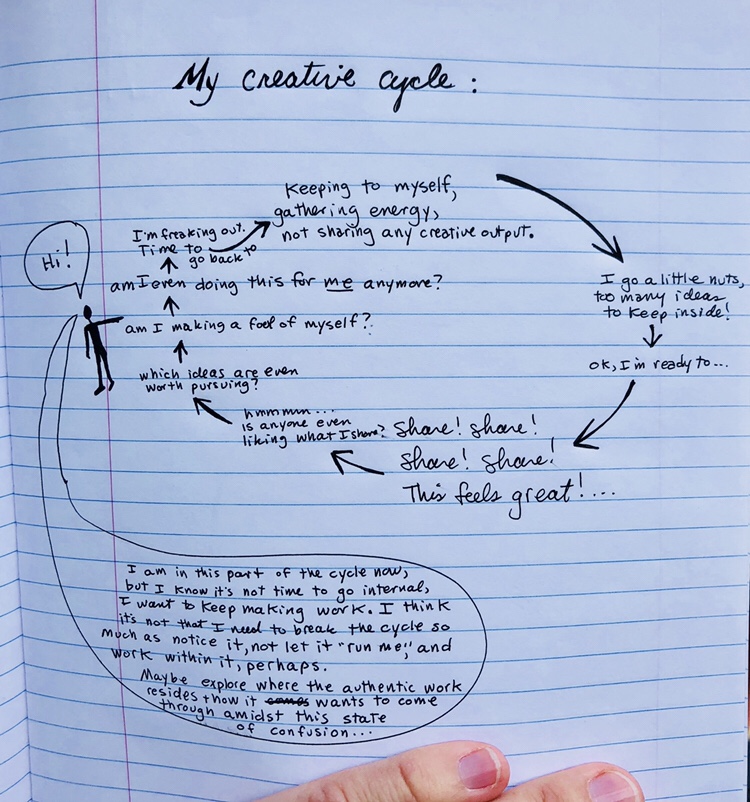
Whenever I get into the state of creative overwhelm, I think, “I have so many ideas and they’re all pretty good and I don’t know which to pick ahhh!!!!!!”

So then I do NONE of the ideas. 🙂

I’m doing my best to work within creative overwhelm, and I think the antidote to it could be organization.

But then I think, “I like organizing. What if I spend too much time organizing and don’t ever get to doing the actual work? Ahhhh!!!!”

(My inner dialogue is very dramatic.)

It seems that finding a balance between brainstorm and brain-restraint is key.

Today I spent an hour planning the week ahead, including which blog posts and Instagram posts I’ll put up this week. This gives me leisurely weekend time to work on illustrations, as well as an unexpected bounty of peace of mind.

Maybe somewhere in the middle of brainstorm (artistic blustering) and brain-restraint (organized scheduling) is a nice happy state. Braincalm. Ahhh. It kind of sounds like a brand of medicated lotion, but I’ll roll with it for now.

We’ll see if it works!

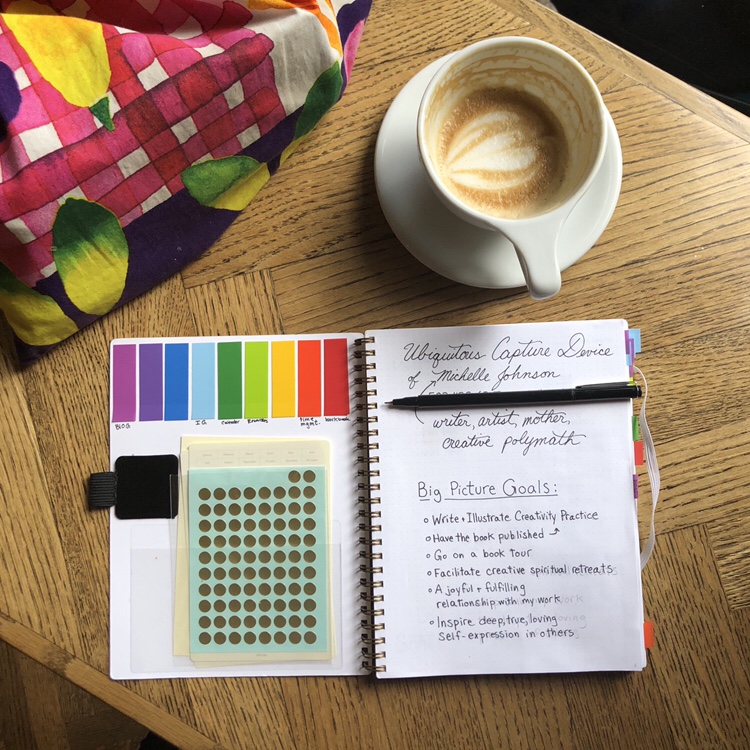
(I use the “Ubiquitous Capture Device” aka, the really tricked-out notebook above for organizing my work. I got it at 11:11 Supply, a great store built around goal-setting here in Portland.)