What Am I Teaching?

A few weeks ago as I was leading my martial arts class in a local park, one of my students said to me, “I just saw a friend walk by and I know he’s going to ask me later what I was doing here. I’m not sure what I should tell him. What are we learning here? What is this class called?”

Her question shocked and delighted me–she had been in my class for months and after all that time she was asking me what the class actually was. She asked for words that described what we were doing. I stammered for an answer. “Umm, well, it’s called Women’s+ Martial Arts, and we’re learning martial arts, but not in a traditional sense. We’re training some internal arts, but also some external. And some self-defense… I think you should tell your friend it’s a martial arts movement class.” I felt pretty good about my answer, but didn’t feel like it was entirely complete. I told her after class that I appreciated her question and would continue to think on it. I told her I would also start writing out our curriculum so we could all get a clearer sense of what we were learning.

My big takeaway, though, was that I needed to answer a simple, foundational question for myself and my students: What are we doing here?

I’ve been thinking about my answer ever since, and I have been thinking about how important her question was. Clarifying what we are learning and why is an important task for a teacher who wants to have good communication with her students.

I started by writing out a rough curriculum of what we practice in class:
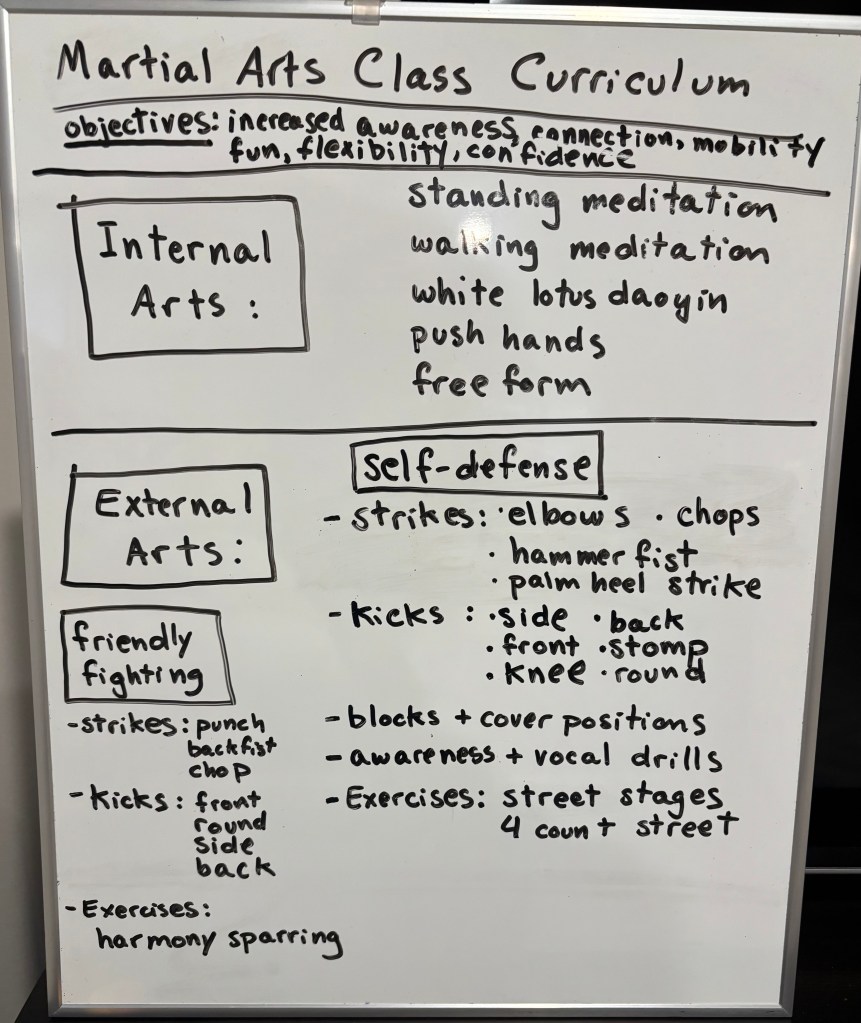
Writing this out also helped me notice my goals for our class. In my younger days, my goals as a martial artist were much different than they are now. Back then I wanted to be tough and strong. I wanted to be a formidable fighter, win at tournaments, and get my black belt. But I also wanted to be part of a martial arts community in which we were doing internal work to become our best selves. I felt like I had all of those things for a while in my Mo Duk Pai days, but after having a baby, everything changed.

I had worked so hard to become tough and strong, but after having my son, my body was stretchy and weak. I couldn’t train as hard as I used to, but my training partners still hit me as hard as they had before. They hit me too hard, and unfortunately the culture in the school was such that I didn’t feel safe speaking up and telling my fellow students to go easier on me. That would’ve been showing too much weakness. And so, because I was afraid of getting seriously injured in training, I left Mo Duk Pai.

When I returned to martial arts with a new teacher a few years later, I started noticing how toxic and subtly sexist the culture had been in my old school. I realized that I no longer wanted to buy in to the notion of trying to be the toughest kitty in the class. I wanted to move my body joyfully and be healthy and injury-free.

My goals for my students now are informed by these past experiences. Most of all, I want my students to feel their own embodiment. I want them to notice the messages their bodies are sending them, and I want them to practice listening to their own selves. I want them to be confident and strong, but I want their strength to come from sensitivity and awareness, not toughness. I want them to know themselves well, and to have the courage to speak their own truths. I also want us to have a joyful, vibrant community based on respect and our shared personal growth.

The moves we practice are all vehicles for working on these deeper issues. Our internal arts practices allow for deep listening inside of ourselves, while our external practices help us in setting and maintaining healthy boundaries. We practice moving martially to defend ourselves, but also to keep our bodies flexible and agile as we age.

So, the core of what I teach is embodiment, mindfulness, and standing up for ourselves. In this sense, martial arts is simply the context for working on a deeper connection with ourselves and each other.

Femm Fighting May 2025

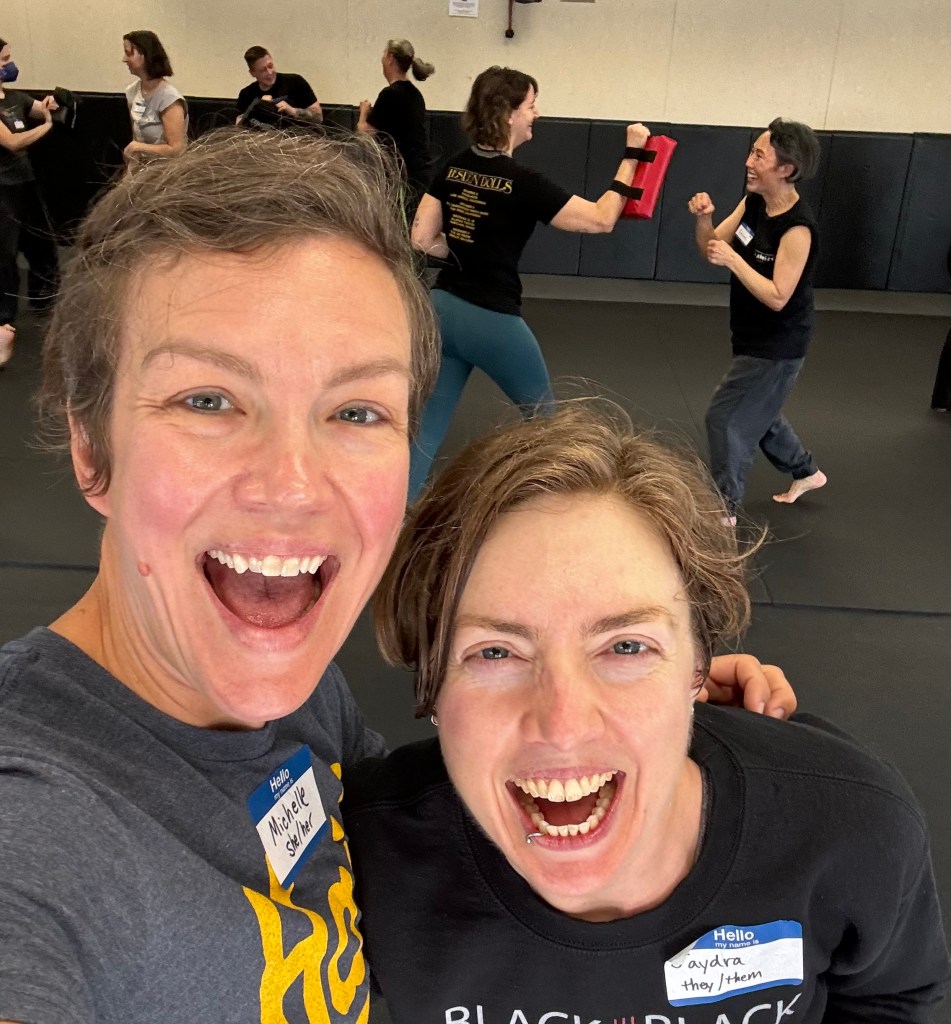
On May 17th, 2025, Jaydra Perfetti and I hosted our second Femm Fighting at Southwest Portland Martial Arts. We had so much fun! This time around we had organizing help from Lark Pien and Shelby Scott, two wonderful local martial artists who also agreed to be our teachers for the day. 

We were so glad to have five folks from Seven Star Women’s Kung Fu in Seattle join our event. They brought with them a spirit of joy and camaraderie that spread throughout the group. We also had a great group of local martial artists, including some returning attendees from the first Femm Fighting.

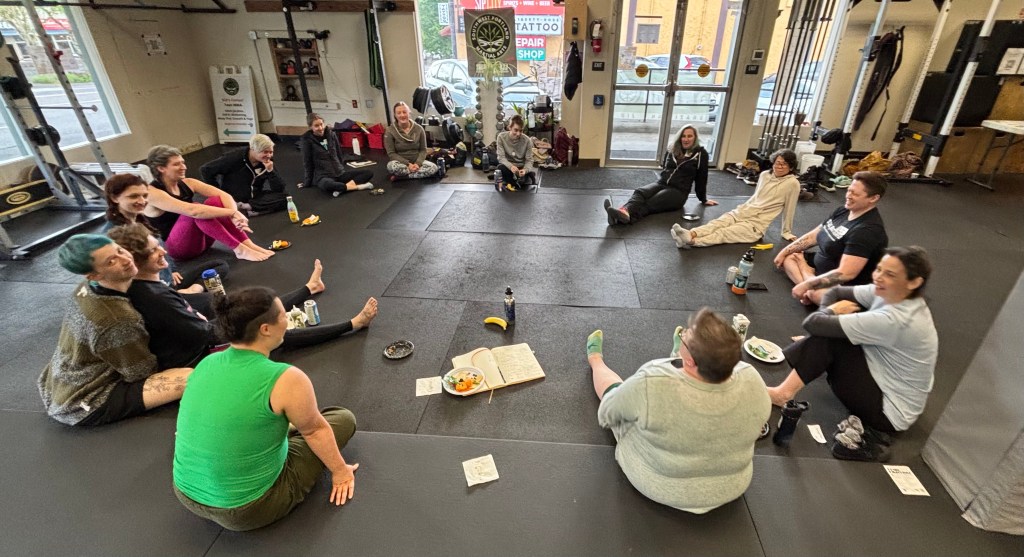
We opened the event by sharing our names, pronouns, and martial arts styles. Shelby also suggested we share our “Martial Arts Persona,” which added a fun element to the opening circle. Some of them were “Annoying Sibling,” “Superhero,” and “Sneaky.”

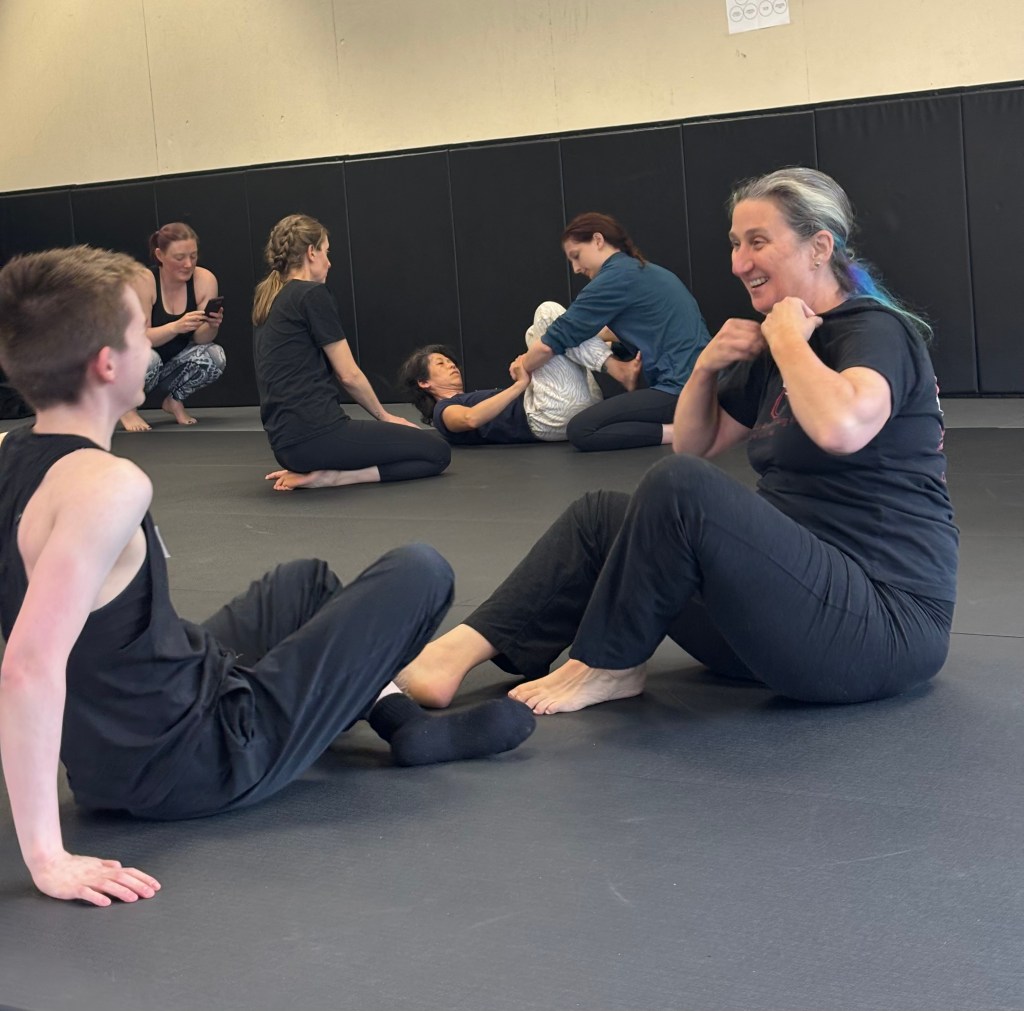
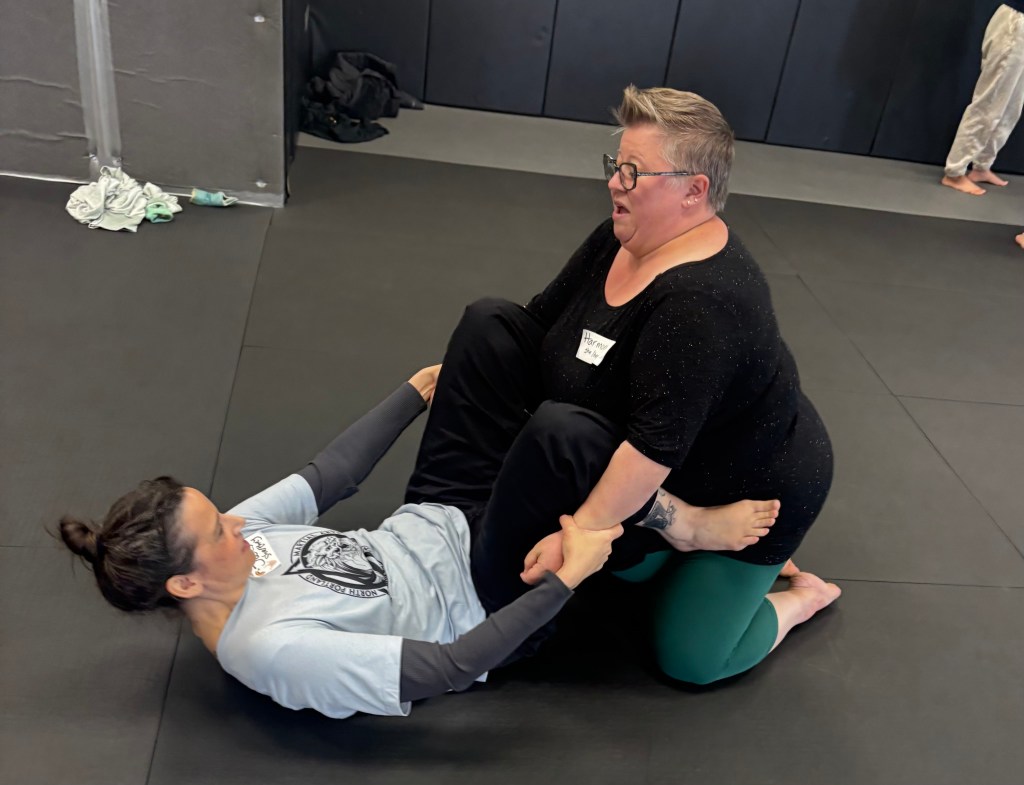
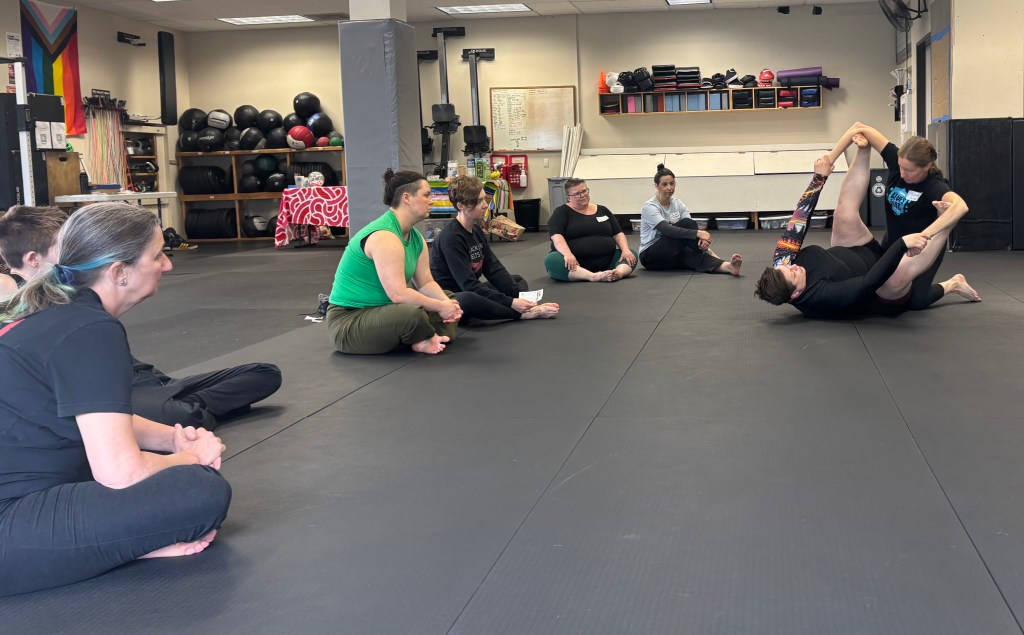
Shelby, a Brazilian Jiu Jitsu teacher, led our first class. She showed us defensive maneuvering from the guard position that had us using our feet in ways most of us had never thought to. The moves were so new and fun that soon we were all rolling with laughter. Shelby taught at a great pace and answered our many questions with clear demonstrations and patience. Being in a room full of experienced, dedicated martial artists who had great control and thoughtful questions felt nourishing and grounding.

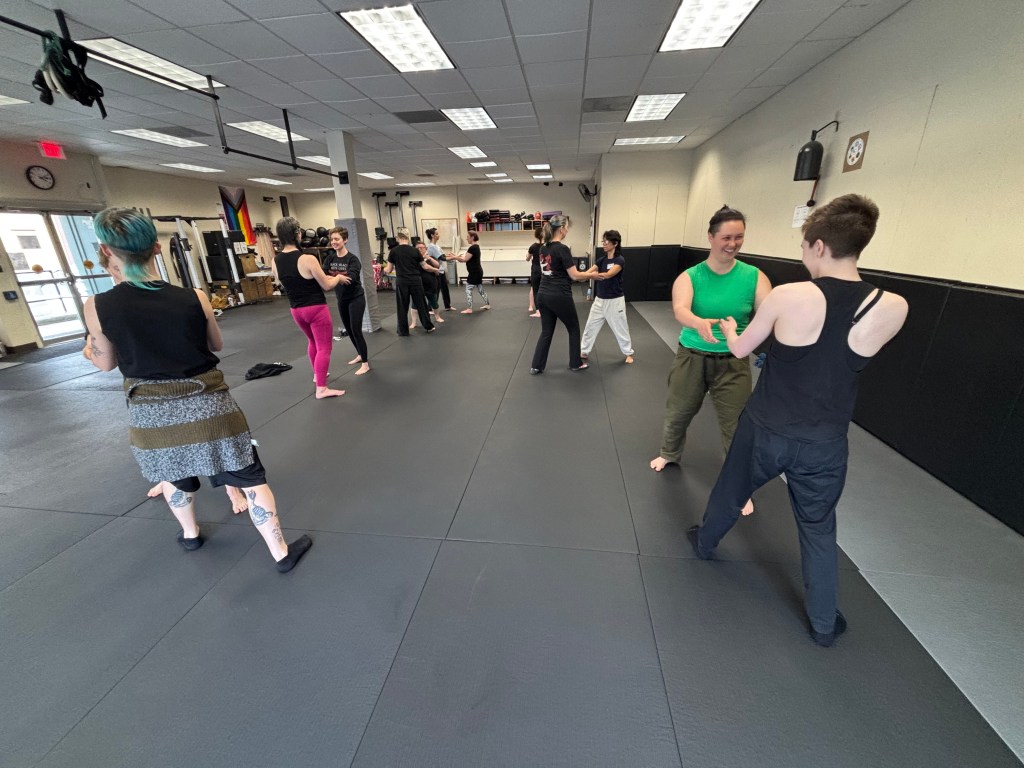
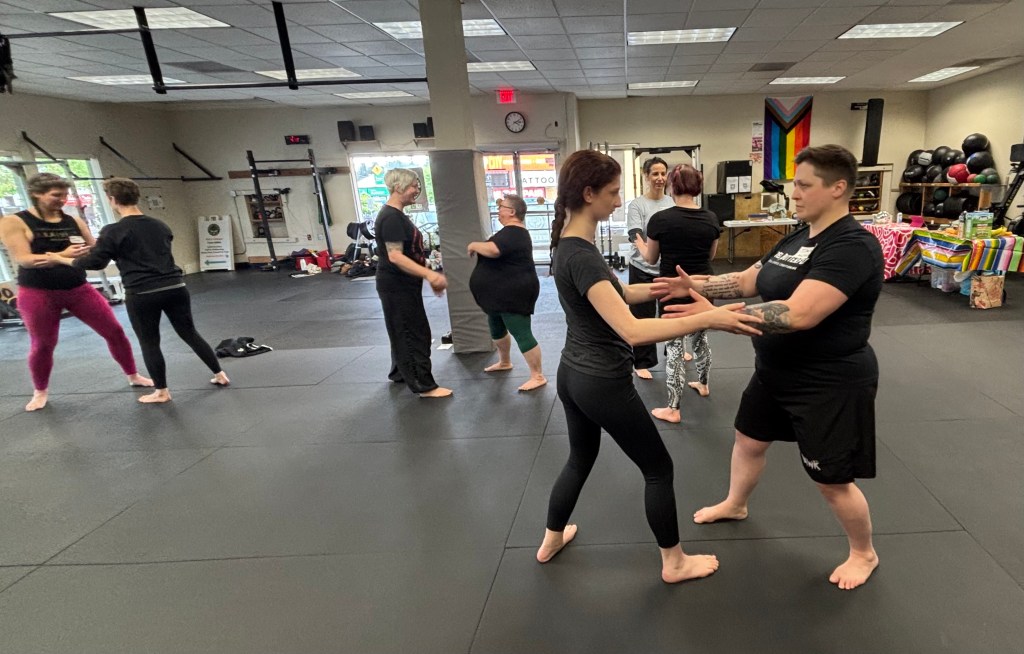
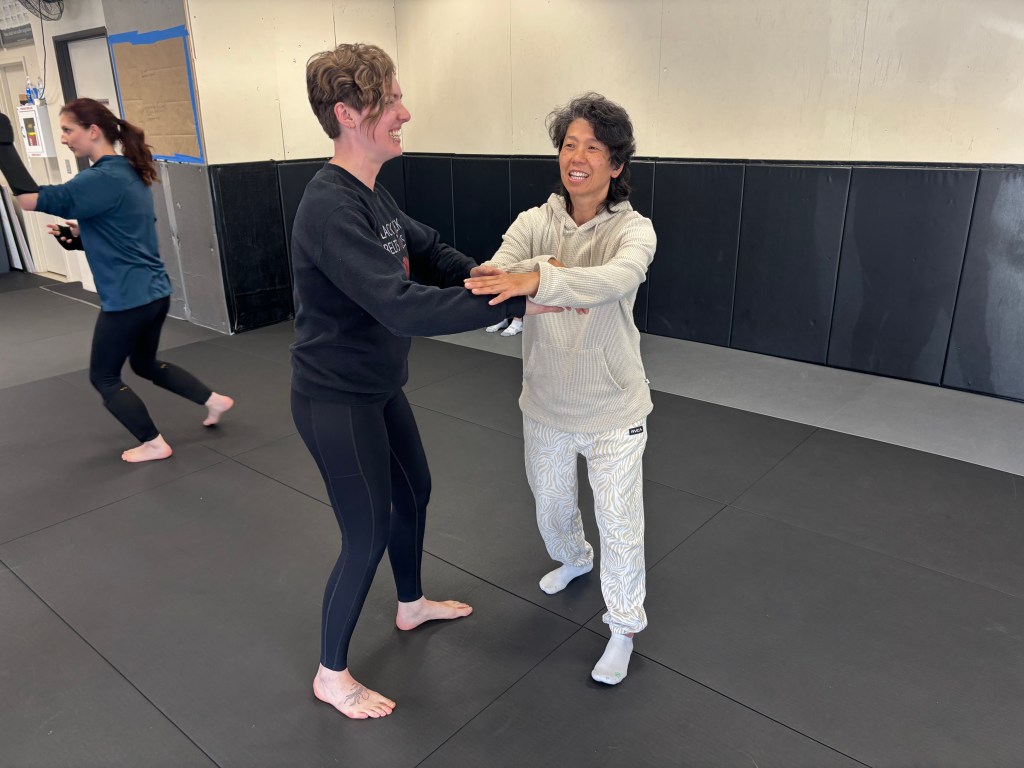
For our next class Lark, an internal arts teacher, led us through a breathing exercise that had us breathing in through the ground up into our bodies. This created a lovely connection in our bodies and a peaceful sense of togetherness as we stood and attended to our breathing together. Lark next led us in an exercise where we got to feel the subtle power that we tap into when we allow our joints to open. The power of the internal arts can feel like magic, and this joint opening partner exercise helped us feel internal force with each other in a tangible way.

After Lark’s class we took time for snack (yay!) and discussion (also yay!). Jaydra opened discussion by pointing out that the work of the martial artist is the same as the work of liberation and anti-oppression. As martial artists we are looking to know ourselves really well so that we can stand up for ourselves. We learn to cultivate our own awareness, power, and control so that we can use them effectively to make positive change in ourselves and the world around us. Jaydra posed 4 questions, one at a time, and we went around in a circle to offer our answers.

The discussion questions were:

  1. Martial arts learning is more often than not influenced by hierarchy. How can we adjust that system and structure to make sure each person’s value is recognized and appreciated, and the folks “at the top” are not raising themselves up by pushing others down?
  2. What are you doing to nurture your liberation and anti-oppression work:
    1. In your own heartspace?
    2. In your dojo or school?
    3. In the greater world or other parts of your life?

The answers from the group were wide-ranging and mind-expanding. Being in a group full of caring people who are doing the hard work of liberation was deeply inspiring. The discussion was meaty and thoughtful— you can read the full discussion notes here.

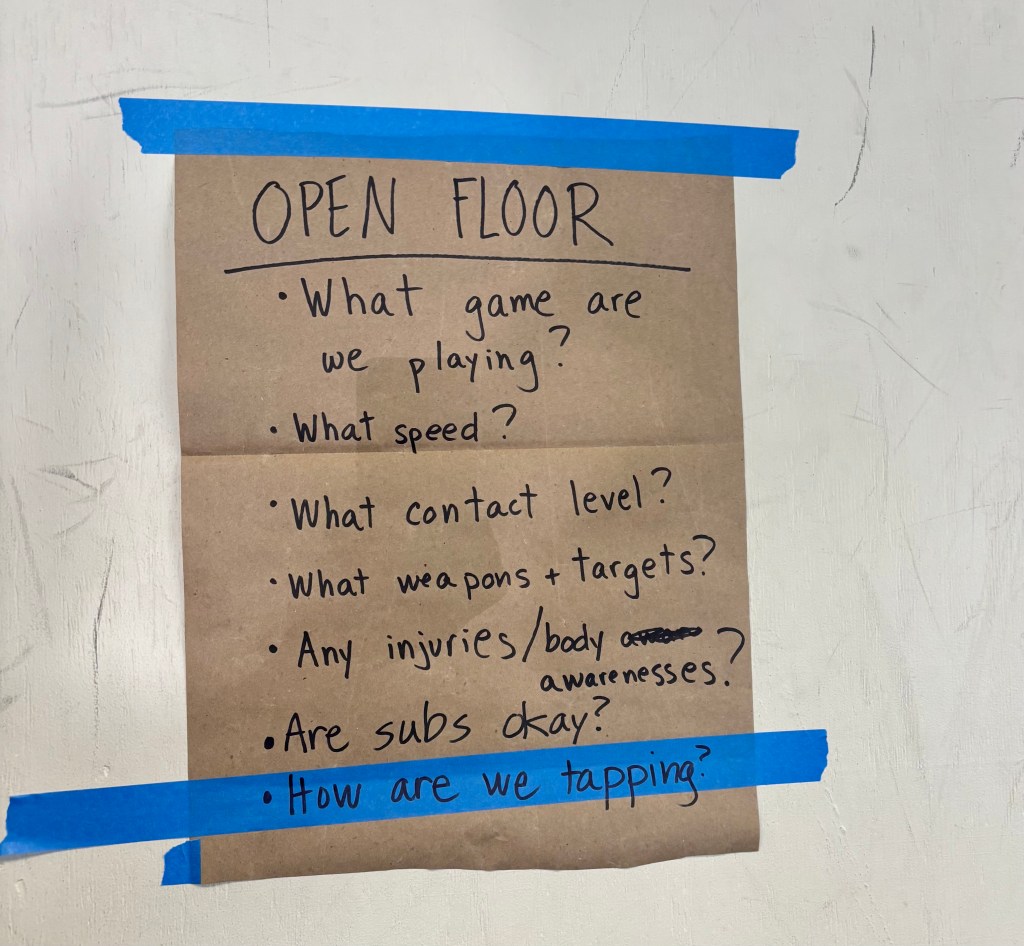
After our discussion, we stretched our bodies and headed into open mat and sparring time. I set the stage for open mat by going over expectations and how to make agreements with partners. At the last Femm Fighting folks felt that the open mat time was too short, so this time we allowed a little more time for open play. Much better! People practiced sparring, forms, jiu jitsu, and other martial arts partner exercises. I led this part of the event by calling 3 minute rounds with 2 minute breaks in between. We tend to be a chatty, social bunch, so the in-between round time allowed us time to recap and talk with each other a bit before going into our next fighting exercises. Everyone demonstrated good communication and good control—we had a safe and joyful open mat time.

After open mat, we circled up and closed out the event by saying our names and styles once more, and sharing something we were taking away from the event. After a short seated meditation, we closed out our group. Then, a group of us went to a delicious food cart dinner. What fun!

Our next Femm Fighting is planned for October 4th, 2025. We hope you will be able to join us!

Femm Fighting Discussion, May 2025

For our May 2025 Femm Fighting, Jaydra led us in a discussion about how we dismantle systems of oppression in the martial arts and in the greater world. The topic was a big one, and our group rose to the challenge and offered thoughtful insights. Being part of such a dedicated group of people who are doing the difficult work of liberation and anti-oppression was humbling and inspiring.

Jaydra’s notes from our discussion are below.

* * * * * *

Here was the lead-in and prompt:
The work of liberation and anti-oppression is the same as the work of martial arts. In both cases we must practice.

Each school/style has their own methods and philosophies for how to make the journey from beginner to black belt, but the end goal is still the same: know yourself more fully so you can know the world more fully.  Martial arts is self-development, which is the same work we all need to do to take down the systems of oppression our society currently runs on.  The greater martial arts community is perfectly situated to act as a leader in the quest for racial justice and other forms of equity.

For example, situational awareness is the most important base skill for practical self-defense.  It is also one of the most useful skills while attending a protest or giving public testimony on a piece of proposed legislation.  And it is vital for dismantling systems of oppression within myself and in society because I have to be able to see what is really happening, I cannot just rely on the narrative offered by those currently in power.

A commitment to life-long learning is also a good example.

Partner work is another great example because none of us exist in a vacuum.

Community & solidarity are critical to liberation and anti-oppression.

Question:
Martial arts is mostly structured in a hierarchy, how can we adjust that system and structure to make sure each person’s value is recognized and appreciated and the folks “at the top” are not raising themselves by pushing others down?

Answers from the group:
School is governed by a committee with reps of all belts from white to black.

Formal policies & structure for grievances. Process for when someone has an issue.

Maintaining a “beginners mindset” as a senior student and teacher.

Free flowing information. Access to info at any belt level.

Asking “what does it mean to be in charge?”

Freedom to ask questions and an environment that doesn’t shut that down.

Leadership to stay open to listening to feedback and concerns.

Personal mission to show up & be in a situation that sucks and practice being okay.

Transparency of process from leadership.

Knowing our lineage and history.

It’s hard to learn when you’re scared.

Practitioners who are also speaking out when it’s needed about what they see as issues

Question (multi-part):
What are you doing in your personal heart space and/or dojo to nurture community and support your liberation & anti-oppression efforts? How are taking your martial arts skills and practice out into the greater world or in other parts of your life?

Answers from the group:
Putting on my invisible anti-bro poncho.

Self measurement of, “am I in a place to be a safe partner?” Recognizing I’m more dangerous when I’m scared.

Going out in nature. Having class outside.

When feeling disempowered or out of control, controlling what I can control about my body (like going to a martial arts class).

Consider the cultural appropriation aspect of our martial arts lineage.

Epsom salt bath.

Choose not to attend a class taught by a certain person.

Take notes & publish zines.

Monthly Qigong sessions at tender Loving Empire.

Make sure I leave my house every day.

Sing loudly in the car.

Only listening to the news in specific short timeframes.

Teaching. Passing on knowledge & helping other people feel more empowered.

Gardening. Walking around the garden and touching all the plants. Digging in the dirt.

Giving yourself space to cry and feel your feelings.

Going to class.

Mindfulness practice.

Talking to the wind.

Delete social media.

Sitting on my couch and doing nothing and valuing that just as much as doing stuff.

Creating Safer Training Spaces

I recently experienced a violation of my physical boundaries in a martial arts training space. The incident was gross and humiliating, and the resolution process has been challenging. But the event has shined a light on how important it is to actively create safe and respectful training spaces. This is especially true for women, gender minorities, and others who may experience discrimination in a martial arts setting.

I’m part of a group of martial arts teachers in Portland who are working to create safer spaces for marginalized groups in the martial arts. I believe that we can create more respectful spaces by setting clear expectations and communication protocols for students and teachers. I’m working on creating these protocols for my own teaching practice. Since martial arts often involves a lot of physical contact, I think it’s a good idea for all martial arts schools to have practices and protocols in place so that all students can train safely and respectfully.

Below are some questions I’m asking as I create my own class protocols. I welcome you to consider these questions for your own organization, and if you’re interested, I invite further conversation on these issues going forward.

Healthy Boundaries Practices:

  • What kind of contact can students expect in the school? (Full-body Jiu Jitsu contact, punches to the face, no contact, etc.)
  • What kind of contact is not OK? (Sexual contact, excessively forceful contact, contact made in anger or retaliation, unsafe contact, etc.)
  • What kind of speech can students expect in the school? 
  • What kind of speech is not OK? (i.e. discriminatory speech, sexual comments, etc.)
  • Are students expected to do exactly what the teacher says, or are they encouraged to speak up for themselves when a particular exercise makes them uncomfortable? 
  • What is the process for handling boundary violations? When a student or teacher’s boundaries are violated, who do they tell? Who will help them resolve the situation? How is the situation documented? What is the process for resolving the issue? How do we know when the issue is resolved?
  • Where are the Healthy Boundaries Practices posted? Are they made available to all students?
  • Even if contact is an accident, a report should be filed to look for patterns of unhealthy behavior

How do you create safe training spaces? Is there anything else we should consider in creating these spaces? I invite conversation, so feel free to email me if you have any thoughts or ideas. Thank you for reading!

Planning for Femm Fighting 2

Hi friends! Last week my friend Jaydra and I met to talk about our ongoing vision for Femm Fighting, the twice-yearly event we are creating for women and genderqueer martial artists in Portland, Oregon. Our next two event dates are Saturday, May 17th, and Saturday, October 4th, 2025. Both events will be held at Southwest Portland Martial Arts. Jaydra and I talked about our overall vision for the events moving forward, our values surrounding the event, and we made a preliminary schedule and To-Do list for May’s event. In the interest of transparency and sharing the planning process, I’m including what we talked about as a blog post. Enjoy!

Why Femm Fighting Exists

Femm Fighting is a one-day martial arts training opportunity for women, genderqueer folks, and others who may experience being a gender minority in the martial arts. The event is open to women and genderqueer folks of all martial arts styles and experience levels. Many of us have experienced gender-based discrimination and other forms of discrimination in the martial arts, and Femm Fighting exists as a safe space for us to learn, train, grow, share, and practice together.

Vision for Femm Fighting

The goal of Femm Fighting is to create community among women & genderqueer martial artists of all styles and backgrounds. We hope that people will enjoy the events and will make friends and connections that will support their training throughout the year. We would like to create a sustainable event that can grow as we move forward. We would like to increase the number of participants, keep participation costs low, and invite other teachers to share their practices so we have well-rounded and diverse martial offerings. We are also open to sharing the tasks of organizing the event with others in the future. So that the event stays true to its intentions, we have started creating a list of values that we hold dear in our training. We hope these values keep us on course and help our events flourish.

Our Values

  • Non-hierarchical skillshare & learning
  • Healthy mind/body/spirit practices
  • Gender Expansiveness
  • Liberation & change-making
  • Sharing tools to interrupt cycles of violence
  • Inclusion
  • Acknowledging Intersectionality
  • Multiculturalism
  • Self-expression & embodiment
  • Protecting ourselves and others
  • Anti-Oppression
  • Sustainable martial practice/longevity in the martial arts
  • Community-mindedness
  • Discussion & education
  • Individual voices & experiences are honored
  • Honest inquiry and compassionate listening
  • Fun & Joy

We noted in our conversation that we are often learning martial arts from cultures other than our own. We aim to be respectful to other cultures’ practices and traditions. We are also aware that tensions can arise in this area, and we will do our best to address these with listening and compassionate conversation.

TO DO List

  • Draft new flyer
  • Create new registration form
  • Email a Save-the-Date to prospective participants
  • Have planning Meeting with Teachers
  • Procure snacks
  • Promote the event
    • reach out to schools
    • post fliers
    • tell friends
    • promote on social media
  • Create a Day-Of Timeline

Femm Fighting 2 Plans

At our next event, we hope to function even more as a hub for connecting people to each other and to martial arts events in the area. We’re planning to invite participants to bring fliers or information about their own women & queer-friendly classes, events, or community resources. The discussion topic we’re floating for our next event is “How do we take our martial art into the world?”

We believe that the work of the martial artist is the work of standing up for ourselves and for others who may experience violence or discrimination. This work is deeply important, especially given the current political climate. We are committed to questioning and dismantling oppressive power structures, and fostering the growth of healthy, inclusive, functional communities.

We would like to make it clear that Femm Fighting is a stand-alone event, and there is no expectation for participants to sign up for anything else or buy anything. However, if a participant finds a teacher they like or learn about a class that they want to try, that’s great!

Jaydra and I led the classes at the last Femm Fighting, and this time we are excited to bring on two other teachers to share their wisdom and skills. We will share more info as planning for the event unfolds. Thank you for reading!