Recently I returned from a weeklong training with my teacher in Canada. My friends and training mates J and N were with me, and the three of us got a lot of quality time with our teacher. When people ask me what we practice with our teacher, I tell them it’s tai chi, but it isn’t tai chi in the traditional sense. We don’t learn any forms or combinations–I don’t know the 108 or the 24 form, I don’t know the precise movements for cloud hands or brush knee, I don’t know how to part the wild horses mane or hold the ball. But I’m getting pretty good at standing.
Our practice together always begins and ends with wuji standing, which is standing meditation in tai chi body position. If our standing isn’t clear, none of our movements will be clear. I’ve been practicing this art for five years now, and I’m finally starting to feel depth and clarity in my standing. So are J & N. Because we’ve finally gotten to this place of clarity as a group, we got to move on to partner work during our time in Canada. This included beginning to practice push hands, my favorite martial game.
Since we don’t get to see our teacher in person often, she stressed that we focus on putting our hands on her and each other and feeling the “one feel” of tai chi that we’re going for. The first time she asked me to put my hands on her shoulders, she demonstrated the feeling of “settling in” to the earth in her own body. It felt as if her whole body was melting downward, sinking. The feeling was like lying down in a bed after a long day and letting everything slacken and relax, except she stood standing, and was still solid in her skeletal structure. When I felt it I thought, “Oh, I can do that,” and I allowed my own body to be invited into the sensation of resting into the earth. I let my legs feel really heavy. The feeling was a letting-go of stress and tension. There was ease and joy in the relaxation. Relief.
We then moved on to offering/receiving. From standing, we allow our hands to open in front of us and feel the sensation of offering ourselves outward in all directions to the universe. We then switch to the sensation of receiving from the universe in all directions. As we practice this, we notice whether we are, in general, in a place where we want to offer or want to receive. Which one is stronger? And then, we practice feeling both at the same time. As we offer, we receive. As we receive, we offer. This is the transcendence of duality that is perhaps the core magic of tai chi. We are never one thing, one direction; we practice always being present in paradox, in all directions at once. This presence offers a liveliness and spontaneity not available if we’re stuck in one mode of being.
A lot of the work we do is emotional–noticing held beliefs and how they manifest as patterns of tension in our bodies, minds, and spirits. But this time in Canada, while we did touch on emotional holding, we practiced more of the physical building blocks of good standing and push hands practice. I kept great notes about all of these things–here is a page from my book:
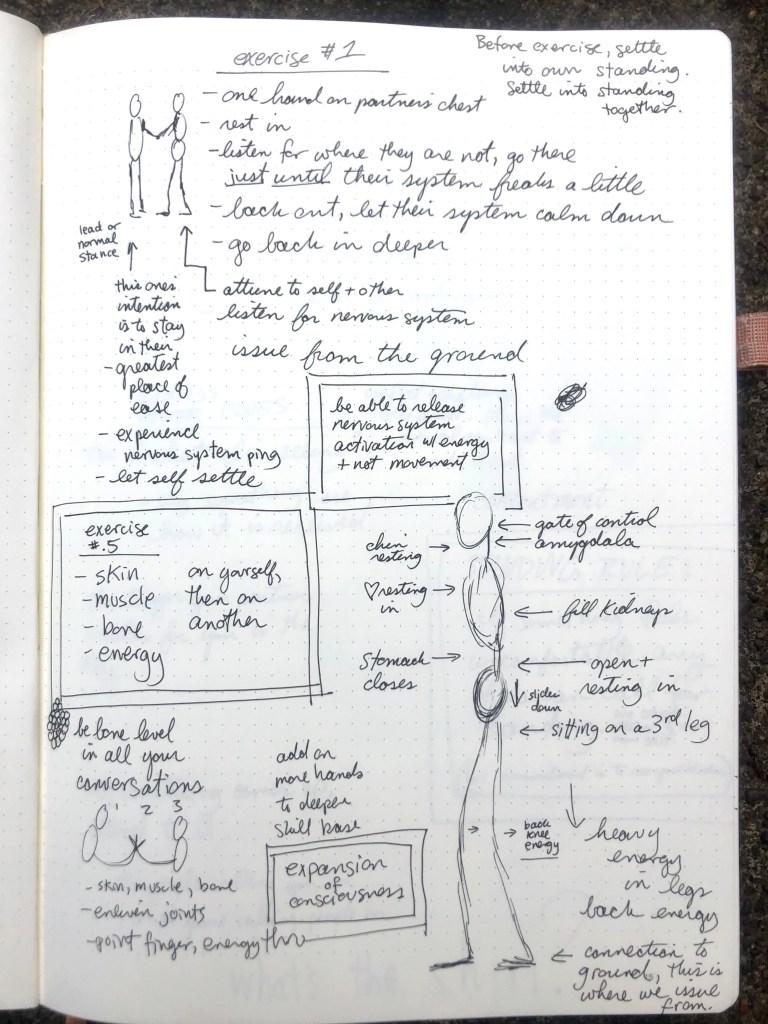
These basic building blocks of standing and push hands include:
• Allowing all the joints of the body to open (feet, ankle, knee, hips, spine, shoulder, elbow, wrist, fingers, neck — everything)
• Resting the internal organs back and down into the pelvic bowl
• Sternum resting down into the pelvis
• Ribcage resting back and down — avoiding popping the ribs forward
• Chin resting down to open the “gate of control,” the place at the back of the head where the vertebrae at the top of the spine meet the cranium
• Kidneys are full
• Energy at the backs of the knees
And then, when we add partner work into the equation, we also must remember:
• Shoulders rest back into the housing as strike moves forward (this one was a game-changer for me.)
• All strikes are initiated with the feet: the arms and hands tend to get hungry and want to lead. Don’t let them!
• Elbows sink and seek the earth (another game changer)
And then, when we touch in with someone, we touch in on the bone level. Our teacher talks about the different levels of touching in to someone else’s body: skin, muscle, bone, energy. The skin level is a surface level, my skin is just brushing my partners. The muscle level is the place where most martial artists touch in during push hands. My muscle meets their muscle, and we tend to get locked into tension. At the bone level, my skeleton is directly connected to theirs. This is where we want to be, at the bone level.
Connecting in at the bone level, I can feel my partner’s skeletal structure, and can notice where their bones our out of alignment. From my connection with my partner’s forearm, I might be able to feel that their left knee is too far forward. I can then consider where my partner is lacking energy–in this case it might be back energy in the knee, or side/side energy–and I can move to unbalance my partner by offering pressure in the direction where they are lacking energy. Of course, a good partner will notice I’m doing this and fill the energetic void, so the idea is to be so subtle that they can’t feel exactly what I’m doing, OR to find two or more places where my partner is lacking and switch between trying to unbalance them in both places. Meanwhile, I have to attend to my own alignment, or I won’t be able to feel into their bones at all.
There are so many considerations, so many potential points of contact, so many energetic directions that the game is a never-ending journey of understanding what it is to have and move a human body.
I just love it.



 Michelle Folk Johnson