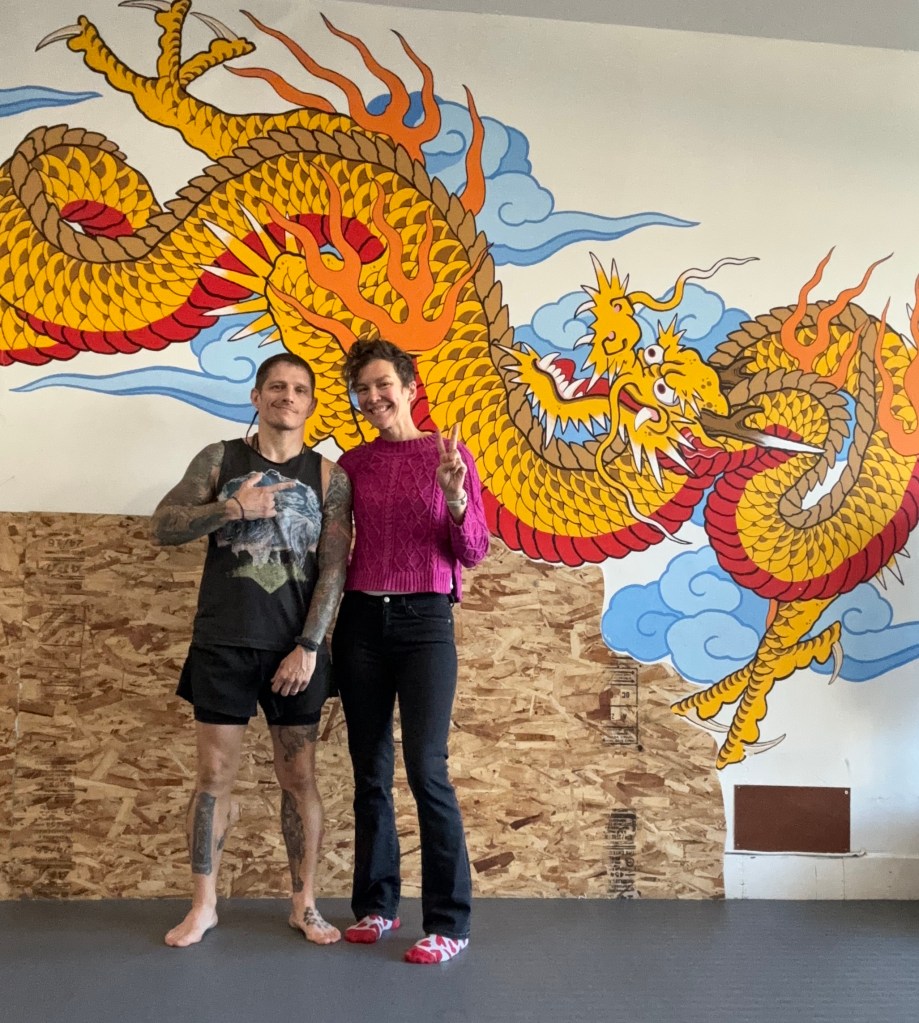
Starting in December I will be leading self-defense classes for women and nonbinary folks at my friend Sifu Michael’s school, North Portland Martial Arts & Movement. We have two December dates scheduled with the intention to continue the series as a weekly class starting in January. Yay!
Dates: Sunday, December 3rd & Sunday December 10th from 3:00 – 4:30 pm
Cost: $20 each or $35 for both.
Location: North Portland Martial Arts & Movement, 728 North Alberta Street
To register, visit the NPMAAM membership page, change the amount shown from $100 to $20 or $35, select “Women’s Class,” and continue checkout.
Each class will begin with introductions, a warm up, and standing meditation. We will connect to our gut area, and practice noticing when we feel good in our bodies and when we feel threatened. From there we will practice spatial awareness and evasive movement exercises (they’re fun!) We will then learn ways to use our voice and body language to set boundaries. Finally, we will learn and practice the best blocks and strikes to use should fighting become a necessity. We will wrap up with a cool down and time for questions, concerns, comments, and feedback.
Wear comfortable clothes you can sweat in and bring a water bottle. And please note: street shoes cannot be worn on the training floor.
My self-defense teaching is largely based on the five fingers of self defense: think, yell, run, fight, tell. Self-defense has very few hard and fast rules, and what is appropriate depends on the situation. Therefore, there is always more self-defense to learn, study, and practice. My intention for the future of these classes moving into 2024 is that the focus be student-led. Students will be invited to bring potential self-defense concerns to the class and we will work through possible ways to handle the scenarios together. In future classes, we could also dive deeper into topics like ground fighting, getting out of grabs and hold, dealing with creeps, and defense against weapons.
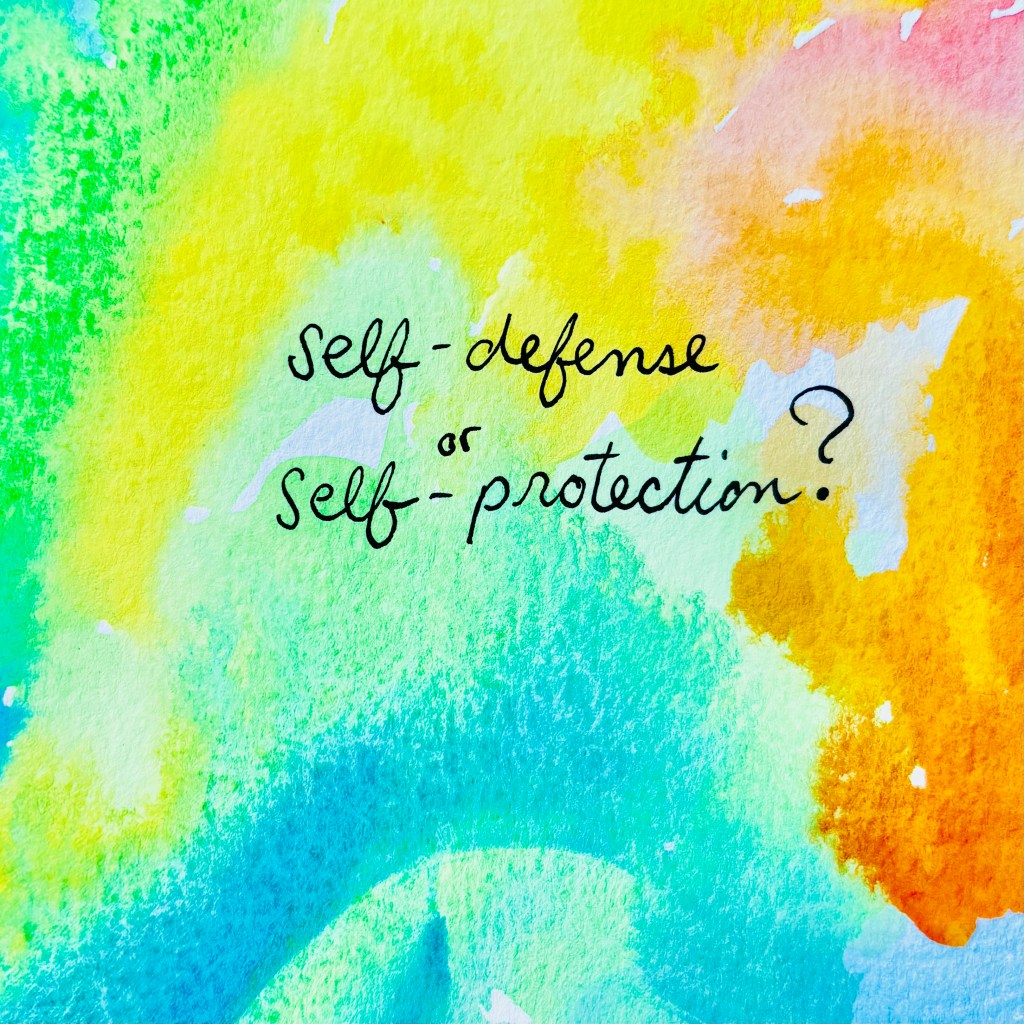
Self-defense can be a mindset, a way of life. It’s a way of life I’ve been living since I first took martial arts classes as a young teenager. But is it a healthy mindset, a healthy way of life?
As a student in my first tae kwon do school in the 90’s, the focus of our youth program was on building confidence, self-esteem, and discipline. We did the endless drilling of kicks, punches, and forms, but we also learned ways to avoid fighting. We were taught to always use our words before our fists. Fighting was a last resort.
I remember with great clarity in one class I took as I was training for my black belt, our teacher, Master Hafner said to us, “I don’t want you to get in a fight, but if you do get in a fight, I want you to win.” I was a bit rattled by this sentiment–the thought of him wanting us to beat someone up. But I was also inspired– our teacher cared about us, and wanted us to care about ourselves enough to fight for ourselves.
Perhaps this is the primary positive mindset of self-defense: I am worth defending, and I will defend myself. I’m grateful that I learned that mindset early on. It can be a mindset of self-love. Years later in my training, as a kung fu student in Portland, another teacher gave me a self-defense golden nugget. Professor Barbara Bones said at a women’s training camp, “Defending yourself is not only your right. It is your responsibility.”
That one still shakes me up inside. To me it means that even if I don’t want to fight for myself, if I’ve lost my sense of self-worth and don’t care if I get beaten up, it is still my responsibility to defend myself to my best ability. There are others in the world that love me, and I owe it to them to be responsible for my own wellbeing. I also owe it to my future self.
Self-defense training has been threaded through all of the martial arts I’ve studied since tae kwon do. Notably, while studying karate at Thousand Waves in Chicago in the early 2000’s, I took the requisite self-defense courses to get my green belt. The self-defense training there was excellent–some of the teachers at Thousand Waves had been involved in the feminist self-defense movement of the 1970’s. Many were from the generation who had to break the gender barrier to be allowed to train in traditional martial arts schools. Training at Thousand Waves gave me a new understanding of the history of women in the martial arts in the United States, and how that history was connected to the feminist movement. I also gained a much deeper understanding of what it meant and what it took to defend myself.
When I moved to Portland in 2005 and started training in Mo Duk Pai kung fu, I got more practical fighting experience than I’d ever had before. Mo Duk Pai is a mash-up of a bunch of different styles, but ultimately a brutal street-fighting art. Once I was training in the higher levels of Mo Duk Pai, we practiced full-contact, full-speed multi-person self-defense drills. I learned the importance of keeping my guard up because I got punched in the head if I didn’t. I learned never to cross my feet when fighting because it’s too easy to get tripped with crossed feet. I learned to make myself big, scary, and loud to intimidate the students who were my attackers.
All of this training was fantastic for my fighting mindset and my confidence, but at one point I started feeling paranoid. I was so used to fighting in class multiple times a week that I almost expected to be jumped in public at some point. I never was jumped, but my stress and paranoia level was certainly elevated during that time. After weeks or months of feeling this stress and paranoia, I realized it wasn’t helping me. I wasn’t any more ready for a fight because I was worried about it. This was the first time in my life that I realized a self-defense mindset could be harmful.
I still think a self-defense mindset can be harmful, and I’ve only come to question it more as I’ve matured in my practice. As a woman, my number one self-defense concern has always been sexual violence. I’m scared of getting groped, assaulted, or raped by a man. The mindset of self-defense assumes there is or will be an offense occurring. And though the offense is happening to me, and the offender is in the wrong, the wrong becomes my responsibility (and some would believe my fault) when it is done to me.
This is an unfair emotional burden that I bear for men’s potential misdoings. I realize I’m being gendered here, because certainly people of any gender can commit violence against me. However, in at least 90% of the self-defense encounters I’ve experienced, the perpetrator was a man (in none of these instances did I have to physically fight). This makes me angry–I see it as just one more way our patriarchal culture tries to keep me small and scared.
That’s a victim-y place for me to come from, and maybe that’s why I don’t like the self-defense mindset–it can be that of a victim. I don’t want to be a victim. I want to be Michelle.
I’m getting back into teaching self-defense in a formal setting this fall, and that’s why I’m thinking about the paradigm of self-defense so much. I don’t want to teach my students to be victims, I want to teach them to be more fully themselves. If something inappropriate is happening to them, I want them to loudly declare that the perpetrator is in the wrong. I want them to know what their boundaries are and to enforce them.
It’s self-protection that I want to teach more than self-defense. Protecting ourselves doesn’t assume offense or defense, it is just protecting what is ours. I want to teach and learn with my students that protecting ourselves is an extension of self-love. Self protection can come from inside of us and radiate outward from us– it is simply us claiming and owning what is ours.
I’m looking forward to what my students and I will discover as I lead classes from this place of loving protection. I’ll let you know what happens.
In the Animal Spirit deck by aritst Kim Krans, which I purchased sometime around 2021, there is a card for the raccoon. Raccoon energy is about wearing a mask, about hiding, but it’s also playful. On the card, Krans mentions that many artists choose to wear masks in the form of an alter ego. She asks us readers to consider how an alter ego might help us on our own journeys.
I took this thought deeply to heart, and I considered how an alter ego could help support me. In the largest sense, I realized it could help me by creating a protective barrier between my sensitive, actual self and the world. A costume, a glittering facade to ward off any darts of hurt that might fly my way as I put myself out there.
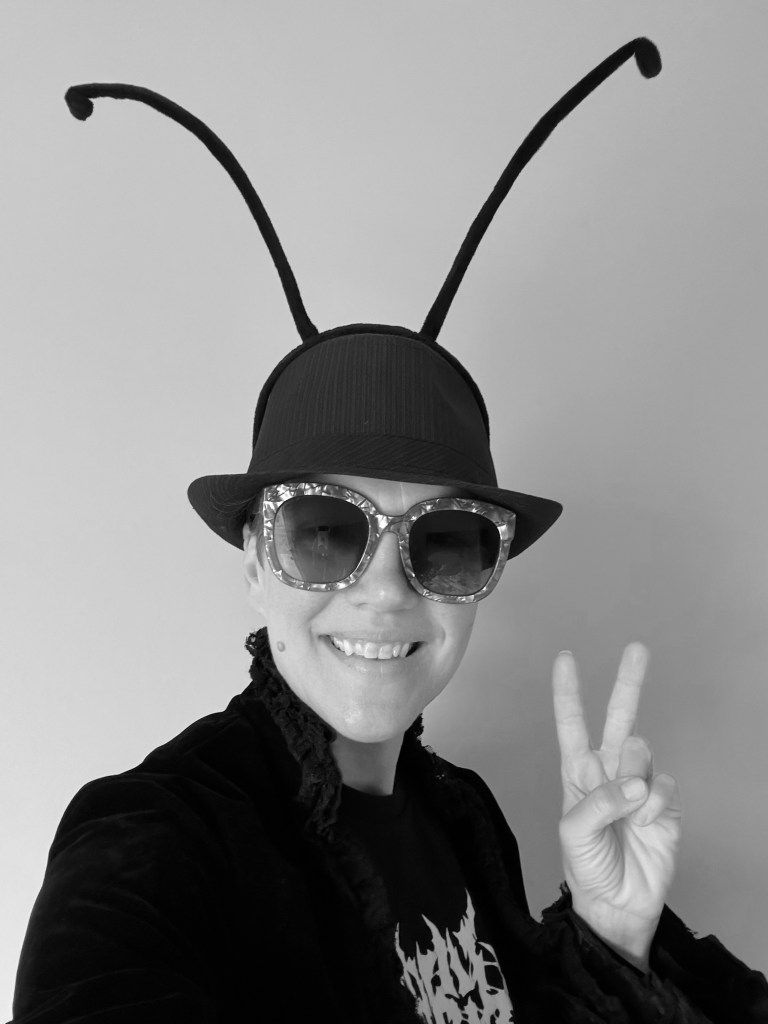
Her name is Madam Ant, my alter ego. She’s pretty formed at this point, I’ve been conceptualizing her and occasionally dressing up like her for the past few years. She’s based on the 80’s British Pop Star Adam Ant, but a woman version. She is a singer, she loves to be onstage, she loves leading parades. She might like to be the Grand Marshall of a parade someday, but for today she would love to be a drum major.
Somehow this persona allows me to speak my truth more clearly. She stands for love, joy, and self-expression. Madam Ant is more direct than I am, she takes no shit. At least, in theory. I haven’t taken her onstage yet. Speaking of being onstage, her outfits are fabulous. She wears lots of velvet and tulle, corsets and feathers, sequins, glitter, lamé. Leggings, fishnets, boots, tutus, ribbons. All the clothes, all the sparkles. There is freedom in how she dresses.
She needs a band, this Ant. She’s scared to actually look for a band– or maybe she just isn’t quite ready yet or doesn’t know how. No, I think she knows where to start, it’s just a matter of starting. She’s just scared to start because she cares so much and this is a big deal to her.
And that’s where Michelle comes back in. Michelle can text some friends and see what Antmusic they want to play. And then Michelle puts on the Madam Ant hat when she plays with those friends and *POOF* Madam Ant is playing with a band.
And sure, it may not be a band that is fully formed or ready to perform, but it will be the beginning of the band that might someday be fully formed and ready to perform.
My tai chi teacher says that the art of tai chi, and the philosophy behind it perhaps, is all about harmonizing polarizations. And we always start by harmonizing polarizations in the self. One way to think of polarizations is to think in terms of projections and hollows–places in our self where we are projecting too much or too hollowed out. Each projection has a corresponding hollow. The projection or hollow can be mental, emotional, spiritual, physical.
As a martial artist, I’m especially interested in the physical manifestation of projections and hollows. In order to conduct energy cleanly through our bodies, say for a strike, we want the cleanest physical and energetic body structure we can muster. Imagine your striking arm is a hose. In order for a hose to transmit energy cleanly, in this case, water, it needs to be open and more or less straight. Once there is a kink in the hose, the water energy can’t get through and gets stuck. That kink is a projection/hollow.
In martial arts we call the energy running through our bodies chi. If our arm is kinked in a way that is causing a projection or hollow, our chi can’t get through, it gets stuck in our bodies, and the strike doesn’t come out clean. Our main concern, though, is not that the strike to the opponent won’t be effective, it’s that we will injure ourselves from repeatedly striking in a way that is not healthy for our bodies. I believe that a lot of martial arts injuries are a result of repeated stress on misaligned bodies, joints especially.
On a more mental or psychological level, though, I find it so deeply interesting to notice where in my life I’m struggling with opposing parts of self. I’ve always wanted to be a mom, and now I am, and I find it terrifically exhausting and occasionally soul-crushing. And yet, I still want to be a mom. (Just, could I have more days off?) I feel like I’m really good at a lot of things, but also never good enough. And all my issues around my dad and money? That stuff is an internal battle of deep, conflicting beliefs about self-worth, sexist family roles, and stress vs. relaxation.
So, maybe this mental battle is why it’s good to get out of my head and back into my body. My teacher believes it all comes back to the body anyway, and I tend to agree. The internal struggle in my body right now, the place where I have the most to grow, is my upper back. Sometimes in my practice I can relax and open my upper back, and I feel the support of my teacher and all of those who are behind me. It is a beautiful, rested-in feeling, a feeling of love and belonging. And yet, it feels too good to be true, so I don’t trust it, and rest back into the tension of trying to project my heart forward, out of my chest.
This heart projection is from a place of need, but is also attached to pride. It is a desperate seeking of love and attention, and a need to feel worthy of that love and attention. The hollow behind it feels like I’m desperately trying to catch something that is always too far away. The way this particular polarization plays out is that when I come to people wanting something from that place of need, they find it distasteful, and they don’t want to offer me what I’m asking for.
But when I rest in to the back, allow my heart to settle down into my pelvis, and find the harmony in the clarity of my back alignment, that feeling of love and support comes over me. The feeling comes from the ground up, behind me, like a cloak of flowers is blooming around behind me and up over my back. I feel loved, at peace, and neediness disappears. And even though I may be by myself, I don’t feel alone, but connected to everything around me.
Recently I returned from a weeklong training with my teacher in Canada. My friends and training mates J and N were with me, and the three of us got a lot of quality time with our teacher. When people ask me what we practice with our teacher, I tell them it’s tai chi, but it isn’t tai chi in the traditional sense. We don’t learn any forms or combinations–I don’t know the 108 or the 24 form, I don’t know the precise movements for cloud hands or brush knee, I don’t know how to part the wild horses mane or hold the ball. But I’m getting pretty good at standing.
Our practice together always begins and ends with wuji standing, which is standing meditation in tai chi body position. If our standing isn’t clear, none of our movements will be clear. I’ve been practicing this art for five years now, and I’m finally starting to feel depth and clarity in my standing. So are J & N. Because we’ve finally gotten to this place of clarity as a group, we got to move on to partner work during our time in Canada. This included beginning to practice push hands, my favorite martial game.
Since we don’t get to see our teacher in person often, she stressed that we focus on putting our hands on her and each other and feeling the “one feel” of tai chi that we’re going for. The first time she asked me to put my hands on her shoulders, she demonstrated the feeling of “settling in” to the earth in her own body. It felt as if her whole body was melting downward, sinking. The feeling was like lying down in a bed after a long day and letting everything slacken and relax, except she stood standing, and was still solid in her skeletal structure. When I felt it I thought, “Oh, I can do that,” and I allowed my own body to be invited into the sensation of resting into the earth. I let my legs feel really heavy. The feeling was a letting-go of stress and tension. There was ease and joy in the relaxation. Relief.
We then moved on to offering/receiving. From standing, we allow our hands to open in front of us and feel the sensation of offering ourselves outward in all directions to the universe. We then switch to the sensation of receiving from the universe in all directions. As we practice this, we notice whether we are, in general, in a place where we want to offer or want to receive. Which one is stronger? And then, we practice feeling both at the same time. As we offer, we receive. As we receive, we offer. This is the transcendence of duality that is perhaps the core magic of tai chi. We are never one thing, one direction; we practice always being present in paradox, in all directions at once. This presence offers a liveliness and spontaneity not available if we’re stuck in one mode of being.
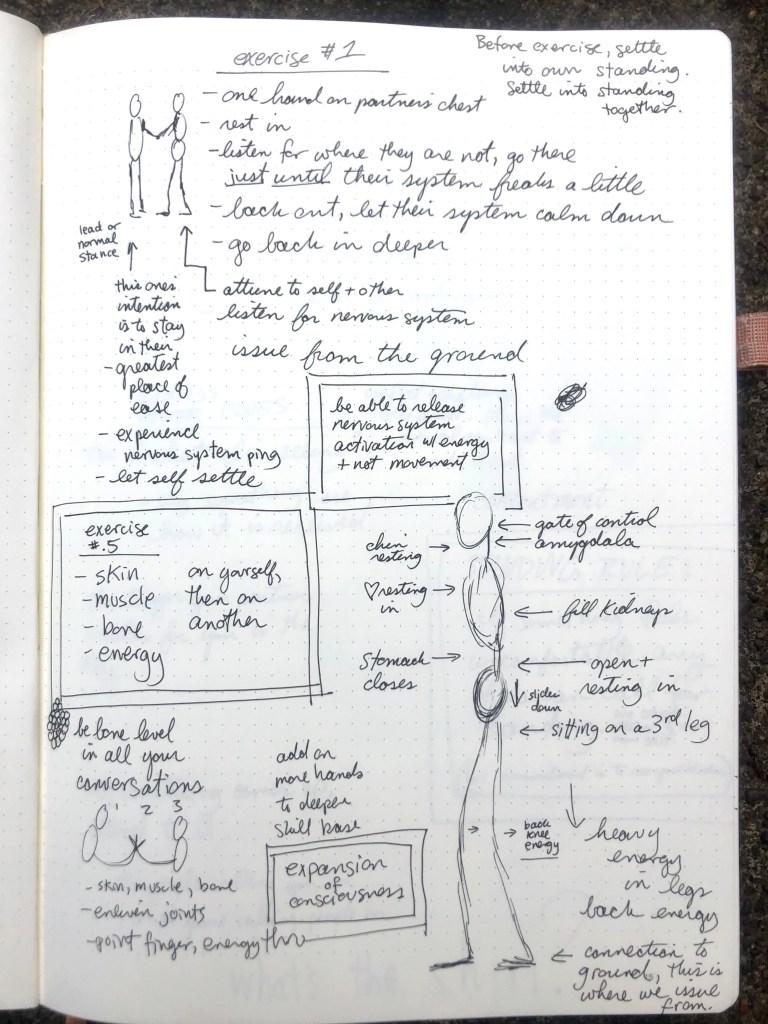
A lot of the work we do is emotional–noticing held beliefs and how they manifest as patterns of tension in our bodies, minds, and spirits. But this time in Canada, while we did touch on emotional holding, we practiced more of the physical building blocks of good standing and push hands practice. I kept great notes about all of these things–here is a page from my book:
These basic building blocks of standing and push hands include:
• Allowing all the joints of the body to open (feet, ankle, knee, hips, spine, shoulder, elbow, wrist, fingers, neck — everything)
• Resting the internal organs back and down into the pelvic bowl
• Sternum resting down into the pelvis
• Ribcage resting back and down — avoiding popping the ribs forward
• Chin resting down to open the “gate of control,” the place at the back of the head where the vertebrae at the top of the spine meet the cranium
• Kidneys are full
• Energy at the backs of the knees
And then, when we add partner work into the equation, we also must remember:
• Shoulders rest back into the housing as strike moves forward (this one was a game-changer for me.)
• All strikes are initiated with the feet: the arms and hands tend to get hungry and want to lead. Don’t let them!
• Elbows sink and seek the earth (another game changer)
And then, when we touch in with someone, we touch in on the bone level. Our teacher talks about the different levels of touching in to someone else’s body: skin, muscle, bone, energy. The skin level is a surface level, my skin is just brushing my partners. The muscle level is the place where most martial artists touch in during push hands. My muscle meets their muscle, and we tend to get locked into tension. At the bone level, my skeleton is directly connected to theirs. This is where we want to be, at the bone level.
Connecting in at the bone level, I can feel my partner’s skeletal structure, and can notice where their bones our out of alignment. From my connection with my partner’s forearm, I might be able to feel that their left knee is too far forward. I can then consider where my partner is lacking energy–in this case it might be back energy in the knee, or side/side energy–and I can move to unbalance my partner by offering pressure in the direction where they are lacking energy. Of course, a good partner will notice I’m doing this and fill the energetic void, so the idea is to be so subtle that they can’t feel exactly what I’m doing, OR to find two or more places where my partner is lacking and switch between trying to unbalance them in both places. Meanwhile, I have to attend to my own alignment, or I won’t be able to feel into their bones at all.
There are so many considerations, so many potential points of contact, so many energetic directions that the game is a never-ending journey of understanding what it is to have and move a human body.